
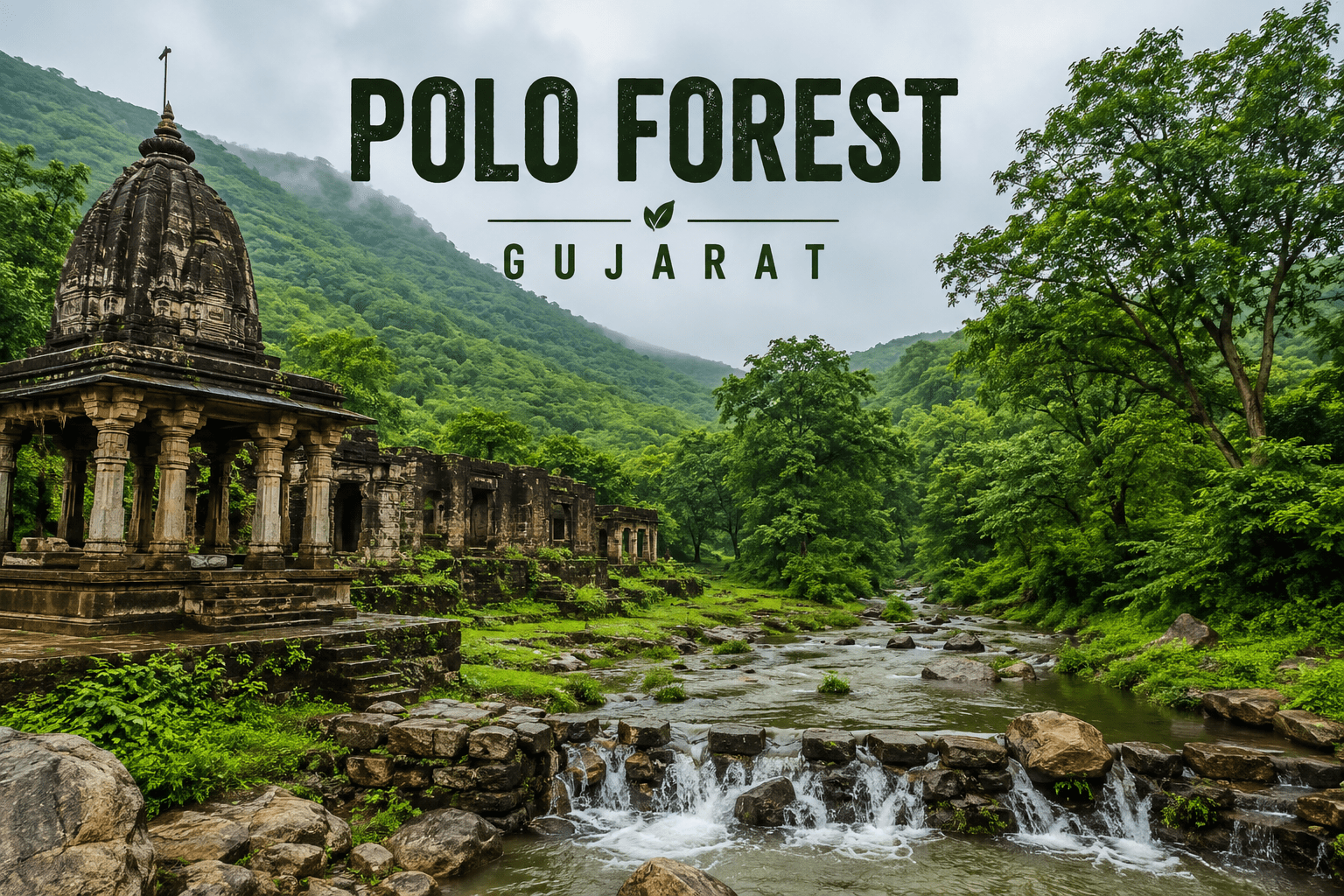
Ask most people planning a weekend from Ahmedabad where they’ll go, and you’ll only hear the same three or four names over and over again. Polo Forest is surprisingly almost never mentioned, and given that, it’s possibly the state’s most underrated secret. It is an expanse of forest in the Vijaynagar region of the Sabarkantha district that blurs the lines between ancient ruins, a river, and forest so dense you can easily forget you’re in Gujarat. Here’s why Polo Forest is so refreshing: it is not just a green cover; it is a place of ancient ruins and temples.
What makes Polo Forest Different from the rest?
You get to see the remarkably preserved ruins of 10th- and 15th-century Hindu and Jain temples. These are half devoured by tree roots and creeping vines, resting lazily on the banks of the Harnav River, without the need for any ticket counter or fencing. You just walk up, and there they are, crumbling in that slow, dignified way old stone does.
The name itself comes from “Pol,” meaning gateway, since this region historically served as a passage between Gujarat and Rajasthan. History shows in odd little details, a carved doorway here, a step-well there, structures that clearly mattered once and now belong entirely to the forest.
The Monsoon Makes the Case for Itself
Polo Forest exists year-round, but it earns its reputation between July and September. The Harnav River, usually calm, picks up pace. Waterfalls that don’t exist in summer show up along the trails, and the whole forest turns a shade of green that photographs never quite capture correctly. Locals in nearby villages will tell you this is when the forest actually feels alive, birds louder, air thicker, everything dripping.
It rains here the way monsoon rain in central Gujarat tends to get heavy for an hour, then a break, then heavy again. Trails can get muddy fast, so this isn’t the trip for anyone precious about their shoes.
Wildlife You Might Actually See
Polo Forest sits inside a wildlife sanctuary, and it shows. Leopards live here, though sightings are rare and not something to plan a trip around. What you’re far more likely to spot are flying squirrels at dusk, a wide range of birds including some species birdwatchers travel specifically to photograph and, if you’re quiet on the trails, sloth bears keeping their distance. None of this is guaranteed, obviously. Forests don’t perform on cue.
Walking Through the Ruins and the Woods
There’s no single “must-do” trail here, which is part of the appeal. You can wander toward the old Shiva temple near the river, sit by the water for a while, then loop back through denser forest where the canopy blocks out enough light that midday feels like early evening. Camping is allowed in designated areas if you’re up for a night under a sky with almost no light pollution, something increasingly hard to find within a few hours of a major city.
The forest department maintains a rest house and a few campsites, though facilities stay basic on purpose. This isn’t a place that’s been smoothed over for comfort, and honestly, that’s the draw.
Getting There and What to Bring
Polo Forest sits roughly 150 kilometers from Ahmedabad, close to Vijaynagar town, and the drive takes you through smaller roads once you’re past Idar. Most people do it as a day trip, though staying overnight gives you the early morning and dusk hours, when the forest is at its quietest and wildlife tends to move around more.
Bring decent shoes with grip, since the trails near the river get slick. A rain jacket beats an umbrella under tree cover. Pack food and water, since options inside the forest are limited to whatever the rest house can offer. And if you’re driving yourself, fill up on fuel before you leave the highway, there isn’t much once you’re in.
A Different Kind of Escape
What stays with people after visiting Polo Forest usually isn’t one big moment, it’s the accumulation of small ones. A stepwell appears out of nowhere on a trail. Rain starts just as you reach the river. The particular quiet that only exists somewhere without a phone signal. It’s not a polished destination, and it doesn’t try to be.
If that kind of unpolished, slow travel is what draws you in, Goya Hills carries the same spirit further south, tucked into the Aravalli hills near Udaipur. It’s a private villa retreat built around the idea that a landscape doesn’t need much added to it, just space to actually experience it.
Take a look at what Goya Hills provides its guests, and if a forest like Polo has you thinking about where the next quiet trip should be.


